When you are responsible for a mixed university estate, campus totals and timetables rarely show where action is justified. Optim Energy gives estates and energy teams a clearer basis for prioritising building operation, compatible controls and capital decisions without overriding specialist constraints.
A campus decision is difficult when one total, timetable or building type hides the operation and constraints that actually matter.
Campus totals do not show which buildings, systems or periods are driving demand.
Teaching, study and work spaces operate differently from their timetables or expected use.
Laboratories, residences, heritage buildings and other specialist areas cannot follow one blanket control rule.
Out-of-hours load, indoor conditions or water use is difficult to investigate across a changing estate.
Estates, energy and capital teams lack a shared baseline for choosing maintenance, controls or retrofit.
You need evidence before a pilot is scaled across buildings with different constraints.
What changes
Know which campus differences matter and where action is justified.
Estates, energy and capital teams can work from a clearer shared evidence base, while specialist spaces retain their engineering, safety and continuity requirements.
See the estate in context
Compare demand, conditions and space use at the building, system and period that matters.
Prioritise with confidence
Distinguish an operational issue from maintenance, compatible controls, a specialist assessment or capital work.
Support accountable decisions
Retain useful baselines and response records for governance, reporting and investment planning.
Not every campus question needs an estate-wide Optim EOS deployment. Optim Energy will recommend a bounded pilot, focused monitoring, an independent assessment or a simpler action when that is the more proportionate next step.
What a deployment could include
One modular campus monitoring and control stack
Optim EOS is the Energy Operating System, Optim Energy's building-performance platform delivered technically as a BEMS. It can bring selected energy, indoor-condition, space-use and specialist equipment data together through suitable BMS, meter and campus-platform integrations. Start with one campus decision, then add buildings, exports or controls only when the evidence and interfaces justify it.
Energy visibility from campus to circuit
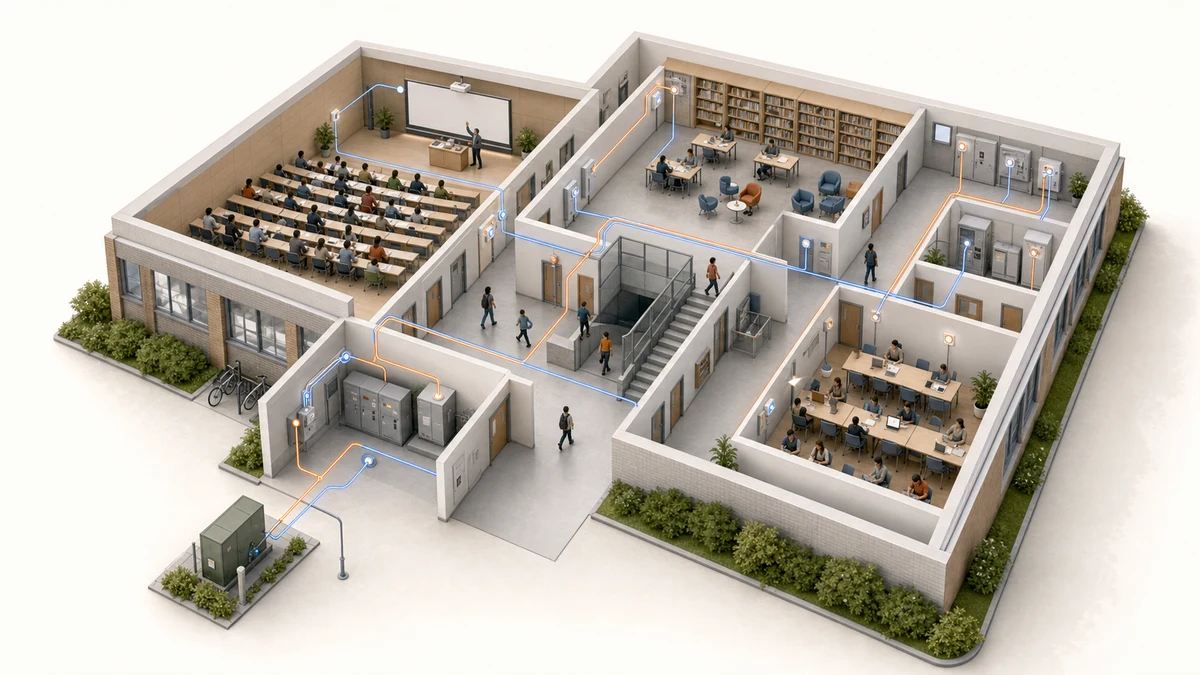
Bring utility, building, distribution-board and significant-user data into a consistent meter hierarchy. Optim EOS can expose out-of-hours loads, compare building profiles and help estates teams move from one campus total to the system or period that needs investigation.
Presence, counting & utilisation evidence
Use the minimum resolution needed for the decision: presence for suitable setback or lighting logic, anonymous counts for capacity and demand, and time-based utilisation evidence for libraries, lecture halls and study areas. Timetables and user input remain part of the picture.
Indoor conditions & ventilation
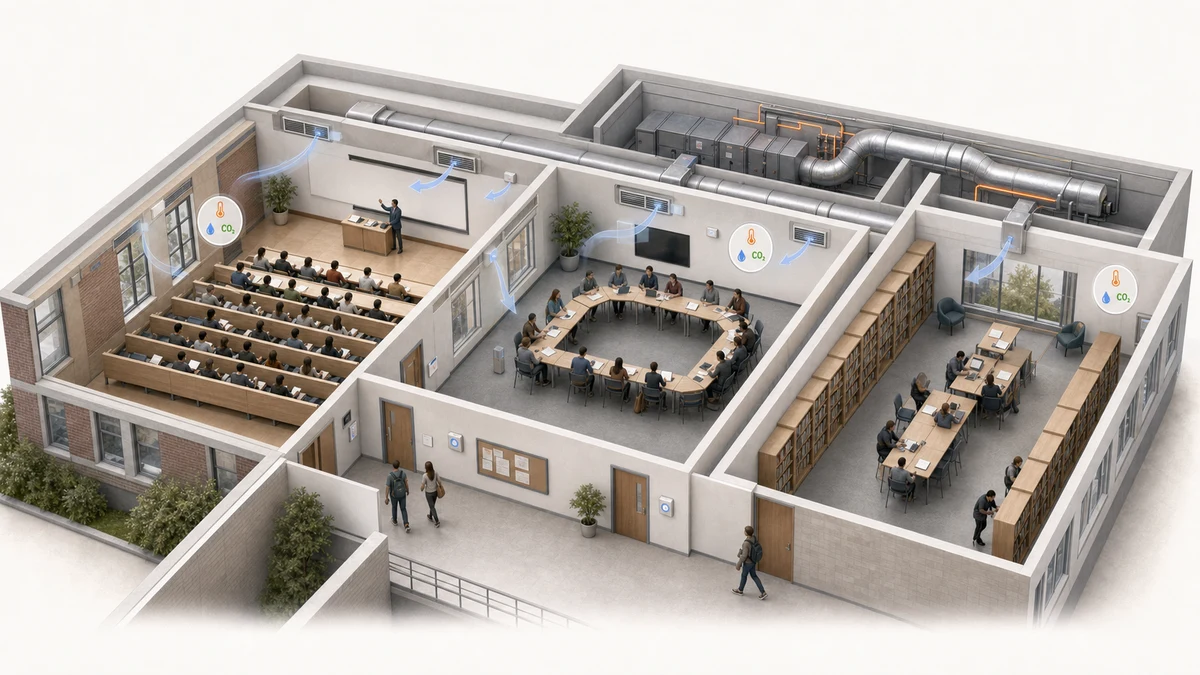
Monitor CO₂, temperature and humidity to find occupied rooms operating outside intended conditions. Where the existing plant supports it, demand-controlled ventilation can respond to real occupant load while retaining the required air quality, comfort, overrides and engineering safeguards.
HVAC, lighting & plant control
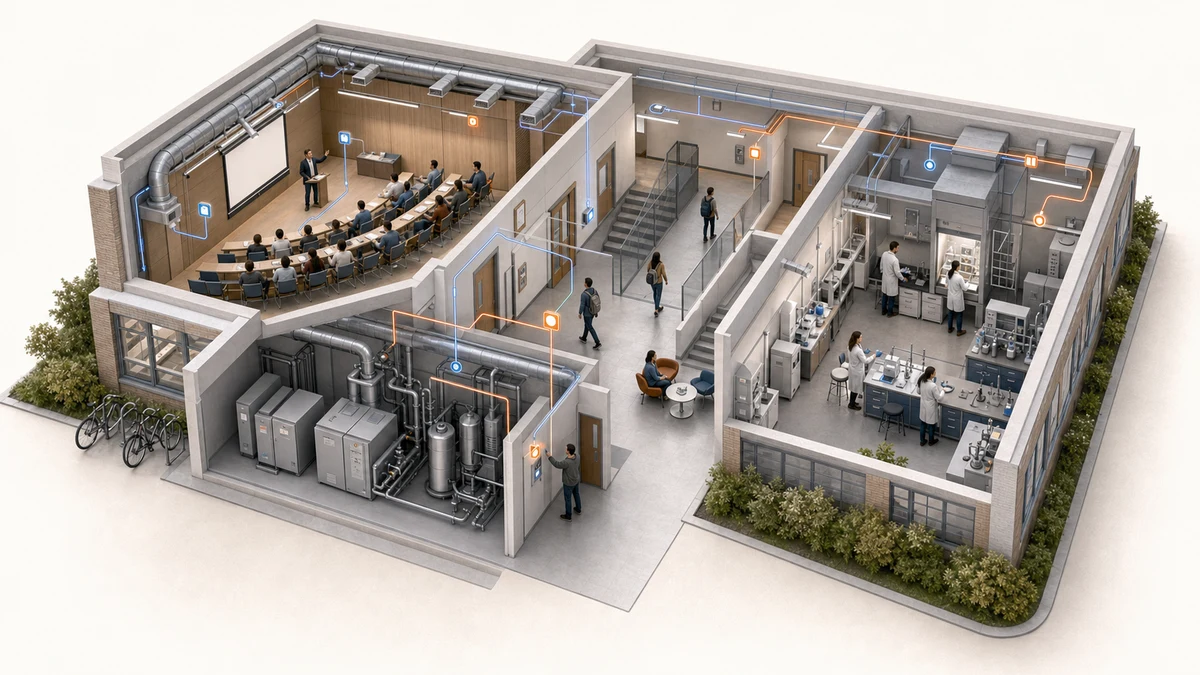
Integrate suitable heating, cooling, ventilation and lighting for schedules, zone setbacks, threshold responses, presence or daylight logic and authorised control. Selected laboratory ventilation, fume-cupboard, ultra-low-temperature freezer or cold-storage signals can provide specialist context where interfaces permit. Their safety, continuity and local control systems remain authoritative.
Water monitoring & leak response
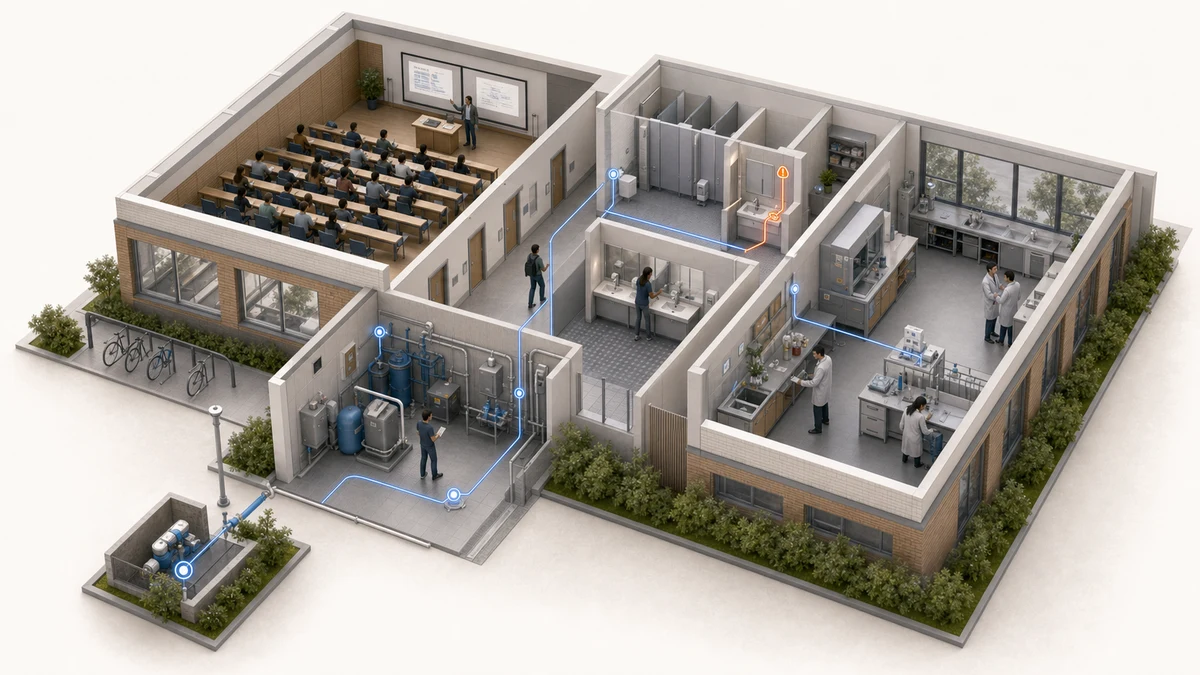
Combine meter trends with point or zone leak sensing at defined risks. Alerts can expose abnormal flow sooner and route it to the right team; local detection, safe shut-off logic and maintenance escalation are designed as separate layers.
One multi-building operating view
Optim EOS, the Energy Operating System, is Optim Energy's building-performance platform delivered as a BEMS. It can connect suitable existing BMS, meters and selected campus data platforms, retaining alerts, responses and operational history. Configurable exports or system-to-system access can support estates, sustainability, maintenance and capital teams without replacing specialist systems.
Specialist and capital options
Use campus evidence without overriding specialist design
Optim EOS can establish duty, conditions and operating context for a decision. It does not replace laboratory safety systems, specialist plant controls or the professional design required for capital work.
Laboratories and specialist rooms
Ventilation, fume-cupboard, freezer or cold-storage evidence can support a competent specialist review while local safety systems remain authoritative.
Plant and building controls
Load, runtime and condition history can help scope maintenance, control upgrades, electrification or plant replacement before procurement.
Water and estate infrastructure
Meter hierarchy, abnormal flow and response history can support separate leak investigation, network work or resilience planning.
Different spaces, different decisions
A shared data layer without a one-size-fits-all control strategy
Campus space
Useful questions
Lecture halls & teaching rooms
Do schedules, occupant load, ventilation, lighting and HVAC operation align?
Libraries & study areas
Which zones are available, underused or outside intended indoor conditions?
Administration
Where do hybrid work, base loads and broad time schedules create avoidable operation?
Laboratories
Which equipment and ventilation systems are significant users, and what specialist safety limits apply?
Sport, catering & residences
How do distinct service hours, hot water, ventilation, refrigeration and occupancy affect the profile?
Heritage buildings
What can monitoring establish before a carefully engineered intervention is chosen?
Evidence for estates decisions
Questions campus evidence can help you answer
These first-party university examples show how estates leaders approach baselines, specialist buildings, daily control and ownership. Published outcomes reflect each institution's scope and conditions; Optim Energy would model your case from your own buildings, systems and baseline.
Build a whole-project baseline
At Maynooth University, SEAI reports 29.5% measurable energy and carbon savings for the complete Technology, Society and Innovation Building Energy Efficient Design project. Its fabric, services, electrification, zoned BMS controls and live energy-and-water dashboard show why estates teams should define and verify the complete intervention rather than assign the result to one measure.
Trinity College Dublin reports that laboratories occupy 22% of its campus space but account for 46% of campus energy. The comparison helps estates leaders decide where specialist metering, operating evidence and engineering constraints need to sit outside broad campus assumptions.
University College Dublin describes campus energy monitoring and BMS capability that remotely monitors and controls heating, lighting and ventilation, supported by its Estates energy team. This is a useful operating-model reference for connecting data, responsibility and action across a large estate.
Dublin City University's ISO 50001-certified energy-management system spans six campuses and uses Estates, university and senior-management energy teams. Its published approach shows why evidence, responsibilities and review need to connect across operational and executive levels.
Optim Energy's selected presence and people-counting sensors can provide anonymous occupied or unoccupied states or aggregate counts without capturing images, video, audio or personal identifiers. That can give estates teams evidence for suitable lighting, ventilation, capacity and utilisation decisions. The university remains responsible for the lawful purpose, access, retention, security and wider data-protection arrangements.
Identifiable video, Wi-Fi analytics or access-control records are different optional sources and are not required for these sensor capabilities. If a university proposes them for a separate question, its data-protection and IT teams should assess that source's purpose, access, retention and security. See the European Commission's guidance on data minimisation.
How we deliver
Start bounded, then scale only when the evidence supports it
1
BMS audit and EOS assessment
Define the questions, owners, buildings, meter hierarchy, interfaces and verification method. Optim Energy carries out the BMS audit and Optim EOS assessment, coordinating an independent whole-building audit or specialist where formally required.
2
Tailored design & business case
Specify the minimum useful monitoring, alerts, compatible controls, safeguards, costs and modelled outcome for a bounded scope.
3
Installation & commissioning
Plan work around campus operations, then validate interfaces, fallback, override and safe operation before the scope goes live.
4
Continuous monitoring & optimisation
Review performance against the baseline, investigate drift and extend proven patterns only where building type, constraints and evidence support it.
Irish pathways
Funding and procurement need institution-specific confirmation
Higher-education routes are not the same as standard SME grants. Programme status, selection, eligible costs, procurement, match funding and approval must be checked before a project relies on support.
Higher Education Energy Efficiency & Decarbonisation Pathfinder
A targeted HEA/SEAI route used to test and scale higher-education retrofit approaches. It is competitive, call-based and selection-based; there is no assumption that a live call, a particular institution or a monitoring project is eligible.
National tertiary capital plans include decarbonisation and energy-efficiency investment, but the headline allocations cover wider tertiary, research and innovation programmes. Availability, institutional allocation, eligible costs and approval must be confirmed.
May provide project-development support for suitable energy-performance contracting or local energy-supply structures. It is not a general capital grant; current eligibility, procurement requirements and support scope must be checked.
Institutional capital, maintenance and performance budgets
A bounded monitoring or control pilot may be assessed through the university's own capital, maintenance or sustainability planning where it meets governance and procurement requirements. The business case should include whole-life cost and a defined verification method.
The SEAI Support Scheme for Energy Audits voucher is not presented as a normal university-estate route: obligated public bodies and larger estates follow separate audit requirements.
Frequently asked questions
Questions from university teams
What should a university monitor first?
Start with a defined operational question rather than a campus-wide sensor purchase. Useful pilots include out-of-hours electricity in a teaching building, ventilation mismatch in lecture rooms, library utilisation, or unexplained water flow. The scope should include the energy, occupancy and environmental variables needed to answer that question, plus a clear baseline and operational owner.
Can Optim EOS integrate with our existing meters and BMS?
Often, but integration depends on the existing meters, plant controllers, protocols, accessible data points and control authority. Discovery confirms what can be read or controlled, where additional metering or gateways are justified, and which specialist systems should remain independent before a design is committed.
What is the difference between presence sensing, people counting and space utilisation?
Presence sensing reports whether a zone appears occupied. People counting estimates how many people are present or crossing a boundary. Utilisation describes how a space is used over time and may combine counts, frequency, timetables and other evidence. The least detailed measurement that supports the decision is normally the right starting point.
Can occupancy data control HVAC, ventilation and lighting?
Yes, where compatible plant and controllers are fitted. It can support zone setbacks, demand-controlled ventilation, lighting automation and schedules that better reflect real use. Every control sequence must preserve indoor-air-quality, comfort, accessibility, safety, specialist-room and manual-override requirements, and must be commissioned before use.
How can universities use occupancy data without identifying students?
Optim Energy's selected presence and people-counting sensors can report anonymous occupied or unoccupied states or aggregate counts without capturing images, video, audio or personal identifiers. The university remains responsible for defining the lawful purpose, access, retention and wider data-protection arrangements. Identifiable video, Wi-Fi analytics or access-control records require their own assessment.
Does monitoring complete SEAI reporting or guarantee funding?
No. Reliable metering, baselines and data governance can support public-sector Monitoring and Reporting, Climate Action Roadmaps, audits and project evaluation, but do not replace those processes or guarantee compliance. Higher-education funding is programme- and call-specific; Pathfinder is selection-based, and eligibility, procurement and approval must be confirmed for each project.
How are campus energy savings verified?
The pilot defines a measurement boundary and baseline before controls change. Reporting-period performance is then compared with that baseline using suitable adjustments for weather, timetables, occupancy, research activity and estate changes. Energy, indoor conditions, operational workload and user impact should all be checked before a pattern is scaled.
Start with one campus decision
Bring the building, operating problem and available data. Optim Energy will help define a bounded monitoring and control pilot with clear ownership, safeguards and verification criteria.